Exploring our family’s genomes with Claude Science
Published
A couple of years ago, I obtained our whole-genome sequencing data from GeneDx—for my wife, our son and myself. Their analysis, ordered by UCSF, had already identified the likely explanation for our son’s rare neurodevelopmental condition: a de novo variant in SPTAN1. I wanted to understand more about it, and whether that understanding could eventually help us pursue a treatment.
I had the files and the clinical background to ask questions. What I lacked was a workable way to explore the data. Claude Science helped bridge that gap, answer several questions I had about our data, and ultimately assemble material for discussions with our neurogeneticist and the n-Lorem Foundation about a potential future antisense oligonucleotide (ASO) therapy.
Getting to grips with the data
Before Claude Science, I tried grappling with open-source command-line tools such as bcftools and subsequently hired two bioinformaticians from top schools through Upwork. They found it challenging to reproduce GeneDx’s variant-analysis workflow, and I still had unanswered questions and uncertainty about how complete the analysis was. After watching the Claude Science launch webinar, I gave it a try.
Our data included VCF files, which list called genetic variants, and three 25 GB CRAM files, which retain the underlying sequencing reads. A variant call tells you what the analysis detected; the reads help you check the evidence.
With all three family members’ data—a trio—we could compare our son’s variants with ours, then examine candidates that appeared absent from both parents. Claude helped establish a workflow I could follow, question and refine.
Questions to help answer
The questions ranged from checking known findings to exploring possible routes to treatment:
- Could we confirm the SPTAN1 variant in the sequencing data and identify any other potentially notable de novo variants in our son that GeneDx might not have called or reported?
- Did our son have significantly more de novo single-nucleotide variants (SNVs) than expected? Around 60–70 per person is a commonly cited benchmark from short-read studies, although the expected count depends on parental ages and how the data are analysed.
- Could we infer whether the SPTAN1 mutation arose in the egg or sperm—and distinguish what the data could tell us about its parental origin from when it arose?
- Did my genome contain notable ClinVar matches—either variants classified as pathogenic or likely pathogenic, or variants associated with drug response?
- Did I have a variant associated with Gilbert’s syndrome that might explain my isolated, mildly raised bilirubin on routine blood tests over the years?
- Could we corroborate the expected absence of reportable ACMG secondary findings, which clinical sequencing labs are recommended to assess when patients consent? And did our WGS results agree with our Natera Horizon prenatal carrier screening results where the tests overlapped?
- Finally, and perhaps most importantly, what could our WGS data tell us about whether our son’s variant might be amenable to gene editing or an ASO approach?
With our neurogeneticist’s guidance, that final question became more focused: could we build a case for an ASO that selectively reduced RNA from the variant-bearing copy, for n-Lorem to consider?
Working through the questions
1. Could we confirm the SPTAN1 variant in the data and find other notable variants?
The analysis recovered the known SPTAN1 c.6958A>G variant: a change from A to G at position 6958 of the coding sequence, using the report’s reference transcript, NM_001130438. Its predicted protein change is p.(Arg2320Gly), or R2320G—arginine replaced by glycine at position 2320. The diagnostic credit belongs to GeneDx.
It also identified a second candidate de novo variant that changes a protein’s amino-acid sequence, in SNRNP35. The report recorded 17 variant-supporting reads out of 41 in our son, with none among 31 maternal or 32 paternal reads. Checking the underlying CRAMs provided stronger evidence than simply finding no matching variant in the parental VCFs.
Getting there involved a correction. An earlier Claude analysis had incorrectly concluded that all his SNRNP35 variants were inherited. A follow-up report traced this to comparing across the gene rather than checking the individual position. Re-examining that position supported a de novo finding.
The clinical meaning was less clear. The report described the amino-acid substitution as conservative, with computational predictions of benign or tolerated effects, and judged its likely significance to be low. Those predictions did not establish that it was harmless, nor did the analysis show that GeneDx had missed a disease-causing variant. It gave us another finding to discuss with our neurogeneticist, with independent confirmation still needed.
2. Did our son have more de novo variants than expected?
The dedicated de novo analysis reported 84 high-confidence candidates: 72 single-nucleotide variants and 12 small insertions or deletions (indels). For an SNV-only comparison, the count is 72. The age model used in the graph below includes both SNVs and small indels, so it uses the combined total of 84.
Getting to that count required more than comparing VCF files. The initial comparison produced over 34,000 candidates that appeared unique to our son. Checking the parental CRAMs and applying coverage and allele-balance filters narrowed that list to 84. A variant missing from a parent’s VCF was not necessarily absent from their sequencing reads.
Claude’s report interpreted the resulting count as consistent with the expected range after accounting for parental age—I was 40 at conception—rather than evidence of an unusually high mutation burden. It cited Jónsson et al. (Nature, 2017), a study of 1,548 trios that counted both SNVs and indels. Adding the study’s published paternal and maternal age equations gives an expected total of about 83 at paternal age 40 and maternal age 34.
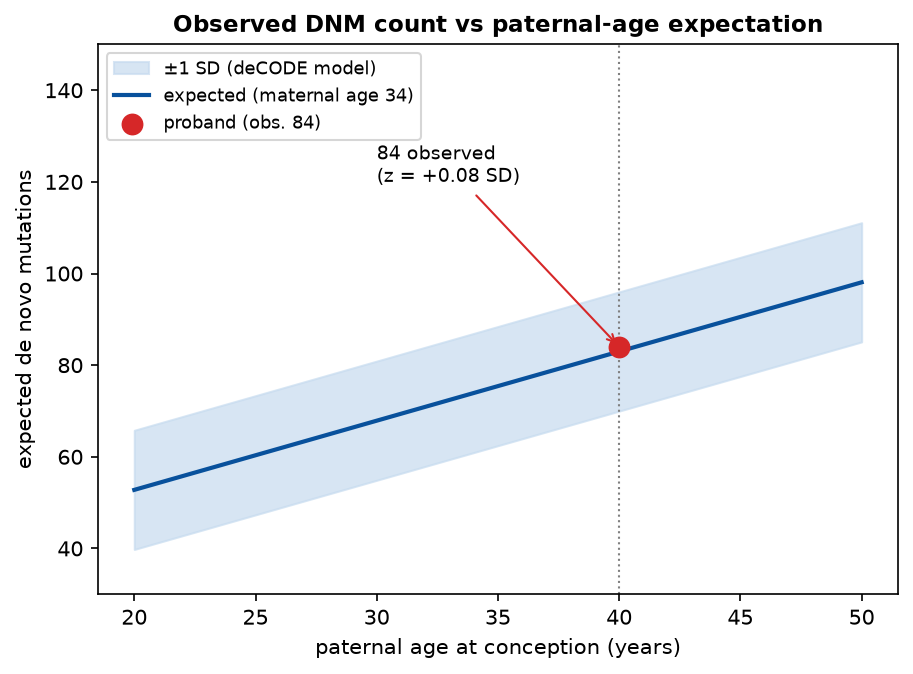
That remained a research interpretation: the calls and the age-adjusted comparison were not independently validated, and the report identified the indels as the less certain part of the count. A typical overall count would also say little about the effect of an individual variant such as SPTAN1.
For us, the takeaway was reassuring: based on this analysis, our son appeared to have roughly the number of de novo mutations expected for our ages at conception.
3. Could we infer whether the mutation arose in the egg or sperm?
Claude’s analysis placed the SPTAN1 variant on the chromosome copy our son inherited from me. That answered part of my question: which parent’s chromosome carried the change.
It used read-backed phasing: finding sequenced DNA fragments that span both the mutation and a nearby marker whose parental origin we could identify. The marker was just 304 DNA bases away. My wife had G on both copies at that marker, while our son had A/G, so his A must have come from me. These letters describe the nearby marker, a separate position from the SPTAN1 mutation itself.
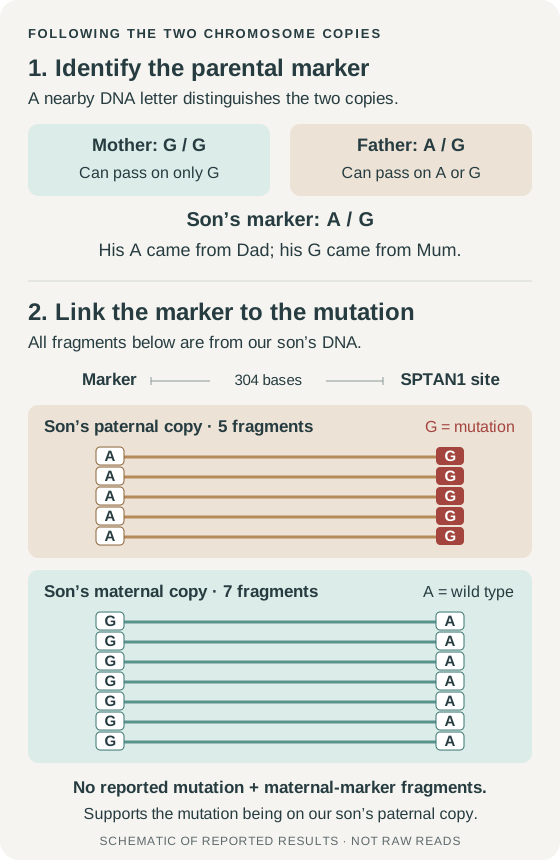
The analysis identified five DNA fragments from our son linking the mutation to the paternal marker, and seven linking the wild-type base at the SPTAN1 site to the maternal marker. None linked the mutation to the maternal marker.
This supported the mutation being on his paternally inherited chromosome. It did not mean I carried the mutation: it was absent from both parents’ sequencing reads at that position. We could infer which chromosome copy carried it, but not whether it arose in a sperm or after fertilization.
The finding also gave us a starting point for exploring how a treatment might distinguish his two copies of SPTAN1. With five mutation-bearing fragments supporting the link, independent confirmation would still be needed before using it to guide a therapy intended to target one copy selectively.
4. Did my genome contain notable ClinVar matches?
I was also curious about my own genome. Claude cross-checked my variants against ClinVar, a database of genetic variants and their reported clinical significance, looking for pathogenic or likely pathogenic matches. I also explored its drug-response and other trait annotations.
The disease-variant screen returned eight matches, but the interpretation was more useful than the headline count. Three were interpreted as recessive carrier findings: variants in PAH (phenylketonuria), ABCC6 (pseudoxanthoma elasticum) and SLURP1 (Mal de Meleda). I carried one altered copy in each case; these findings did not establish that I had those conditions. The other five matches were assessed as common risk associations or weakly supported entries, rather than convincing diagnoses of inherited disease.
The broader search identified 26 variants annotated for drug response, risk factors or traits. One practical example was VKORC1: I was called homozygous for a variant associated with increased warfarin sensitivity and lower dose requirements. This was potentially useful information to confirm if I ever needed that medication. The UGT1A1 finding below also had implications for drug response.
5. Could a variant explain my raised bilirubin?
For years, routine blood tests had shown an isolated, mildly raised bilirubin. I wanted to know whether my genome contained a variant associated with Gilbert’s syndrome that could explain it.
Examining the sequencing reads at UGT1A1, Claude called two copies of the *28 variant—UGT1A1 *28/*28. This adds an extra “TA” repeat to the gene’s promoter, a region that helps control how much enzyme is produced. Reduced production makes the liver less efficient at processing bilirubin. It is a well-established genetic cause of Gilbert’s syndrome, which typically causes mild elevations in unconjugated bilirubin.
That gave me a plausible genetic explanation for a longstanding blood-test finding. My wife and son were each called as carrying one *28 copy.
There was a practical connection to the drug-response search too: UGT1A1 *28/*28 is associated with increased risks of severe neutropenia with irinotecan and jaundice with atazanavir. A finding that helped explain my bilirubin could also be relevant to future prescribing, once confirmed.
6. Did the data agree with our clinical screening?
I also wanted to check for ACMG secondary findings: variants unrelated to the reason for sequencing, but associated with conditions where early detection could guide prevention or treatment, such as certain inherited cancers and heart conditions. Claude screened the 81 genes on the ACMG SF v3.2 list (now superseded by v3.3) and reported no reportable secondary findings in any of our three genomes. That was reassuring and presumably agreed with the secondary findings screen GeneDx would have performed under recommended clinical guidelines.
My Natera Horizon carrier screening provided another point of comparison. Its 400-condition panel had reported three carrier findings in 2023. Comparing those with my WGS analysis gave a more nuanced result than a simple match:
| Gene and condition | Natera Horizon | WGS / ClinVar analysis |
|---|---|---|
| PAH — phenylketonuria | Carrier finding | Same c.721C>T variant identified |
| ABCC6 — pseudoxanthoma elasticum | Carrier finding | Apparently the same c.2542 deletion, described using different reference-sequence naming |
| CDH23 — Usher syndrome type 1D | Variant classified as likely pathogenic | Not listed among the pathogenic/likely pathogenic matches |
| SLURP1 — Mal de Meleda | Outside my panel’s disease list | Additional carrier finding |
The CDH23 difference was particularly interesting. After my Natera report, the ClinGen Hearing Loss Expert Panel classified the same variant, c.9569C>T (p.Ala3190Val), as being of uncertain significance. That could explain why it did not appear in a search restricted to pathogenic or likely pathogenic ClinVar entries and warrants further investigation.
The comparison therefore supported agreement on PAH and an apparent match for ABCC6, while also illustrating how panel coverage and changing variant interpretations can produce different result lists. The UGT1A1 and drug-response findings answered additional questions outside the purpose of my carrier screen.
Could that knowledge help us pursue an ASO?
With our neurogeneticist’s guidance, the work shifted towards a therapeutic question: could the RNA from our son’s variant-bearing copy of SPTAN1 be selectively targeted, and could reducing it help?
ASOs are short synthetic strands that bind RNA. The approach we explored would aim to lower a particular RNA transcript and, consequently, its protein product. It would leave the DNA unchanged.
The rationale depends on how the variant causes disease. If an altered protein interferes with normal function—a dominant-negative effect—selectively reducing it might help. If the problem is too little functional protein—haploinsufficiency—further reduction could make things worse. Studies of some SPTAN1 variants have shown abnormal spectrin aggregation, but that does not establish the mechanism of our son’s variant.
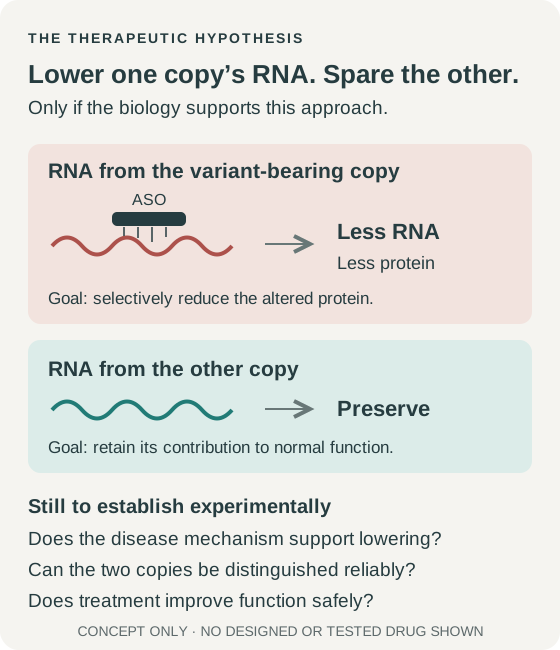
Claude helped explore that rationale and possible ways to distinguish the two copies. Our neurogeneticist suggested checking whether potential target regions also resembled sequences elsewhere in the genome, which could make them less suitable for selective targeting.
The BLAST and BLAT searches were encouraging. Claude screened 54 short stretches of DNA around the mutation and candidate markers across SPTAN1. Thirty-three returned a single genomic match in both searches, including the region containing the mutation itself and the nearby marker used for phasing. Other regions matched multiple locations elsewhere in the genome, helping narrow the shortlist to more distinctive sequences.
This suggested that we might have several possible routes to targeting our son’s variant-bearing copy. An ASO could potentially distinguish the mutation itself, or an inherited sequence difference carried on the same chromosome copy. The analysis identified candidate regions beyond the immediate vicinity of the mutation, giving us more options to explore. These were promising starting points for ASO development: the next step would be to test whether an ASO could selectively lower the variant-bearing RNA and improve function in our son’s cells.
Building a case for n-Lorem
The practical output was a more focused report for clinical discussion and n-Lorem’s consideration: the proposed mechanism, possible routes to selective targeting, and questions requiring laboratory work.
n-Lorem develops personalized experimental ASO medicines through a process involving a research physician, scientific review, drug discovery, safety assessment and regulatory oversight. We have progressed past the initial screening step and are now working towards a more formal assessment, including the initial laboratory work.
As a clinician and a parent, I could bring context and questions. Claude made the computational exploration more accessible, while our neurogeneticist helped sharpen the questions and judge the next steps. Establishing the mechanism, showing benefit and developing a safe treatment remain substantial work.
What changed most was my ability to participate. Files I had struggled to interrogate became a basis for asking more precise questions about our son’s condition—and what we might be able to do next.